
Panama infrastructure plays an unusually important role in the country’s economy and in everyday life. Panama connects the Atlantic and Pacific oceans, serves as a regional transportation and logistics center, and offers modern urban services in its principal metropolitan areas. At the same time, infrastructure quality varies considerably by location, and prospective residents or investors should evaluate the specific community, property, and service provider involved.
This guide explains the main components of infrastructure in Panama, including the Panama Canal, ports, airports, roads, public transportation, electricity, water, telecommunications, and major development projects. It also highlights the practical differences between Panama City, established regional centers, and more remote areas.
Infrastructure should be assessed as a connected system rather than a list of projects. A modern airport or highway may improve national connectivity, but a household or business still depends on reliable local roads, electricity, water, internet access, drainage, and emergency services.
Panama Infrastructure: Quick Navigation
- Infrastructure overview
- Panama Canal, ports, and logistics
- Airports and international connectivity
- Roads and highways
- Metro and public transportation
- Electricity and energy
- Water and sanitation
- Internet and telecommunications
- Regional differences
- Infrastructure projects and development
- What infrastructure means for expats and businesses
- Frequently asked questions
How Modern Is Panama’s Infrastructure?
Panama has several infrastructure systems of regional and international importance. The Panama Canal, ports on both oceans, an international aviation hub, major highways, urban rail, logistics parks, financial services, and telecommunications networks support the country’s role as a gateway for trade and travel.
However, the phrase “modern infrastructure” needs context. Panama City and nearby commercial districts generally offer the country’s broadest range of transportation, healthcare, internet, office, and residential services. Other established areas, including parts of Chiriquí, Coclé, Colón, and the central provinces, may also provide strong infrastructure. More rural, mountainous, island, and indigenous regions can have fewer service providers, longer travel times, and less redundancy when a road, utility, or communications network is interrupted.
For relocation or investment decisions, national averages are less useful than property-level due diligence. A practical assessment of Panama infrastructure should verify access roads, drainage, electrical capacity, water supply, mobile coverage, fixed internet availability, waste collection, and travel time to hospitals, schools, ports, or airports.
The Panama Canal, Ports, and Logistics Infrastructure
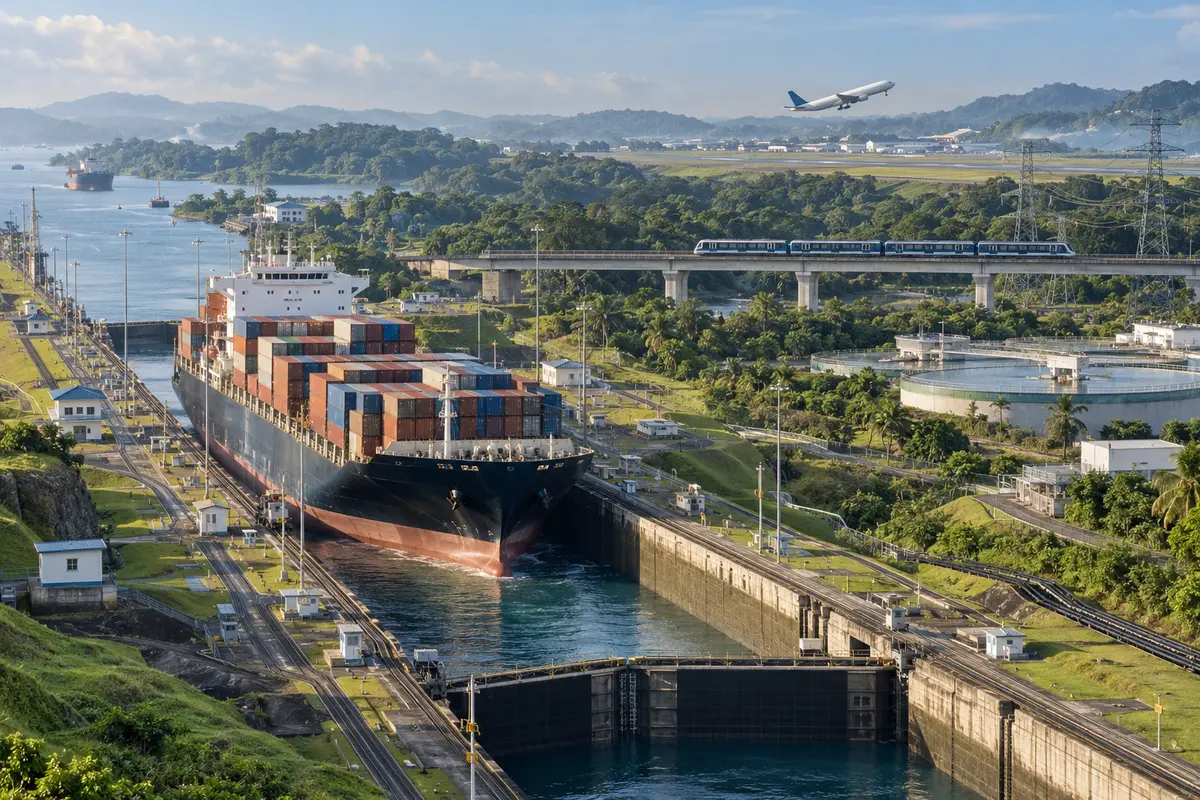
The Panama Canal is the centerpiece of the country’s transportation infrastructure. It connects shipping routes between the Atlantic and Pacific and supports a wider logistics platform that includes ports, warehouses, container terminals, free zones, maritime services, ship repair, trucking, rail connections, and distribution centers.
The Panama Canal Authority operates the waterway and publishes official information about maritime services, transit statistics, regulations, water management, and infrastructure projects. The Canal’s expanded locks allow it to serve larger vessels, although transit capacity and operating conditions can be affected by water availability, maintenance, demand, and vessel restrictions.
Panama’s port and logistics infrastructure is distributed across both coasts. Terminals near the Atlantic and Pacific entrances to the Canal allow cargo to transfer between ships, roads, rail, warehouses, and distribution facilities. This multimodal system is one reason companies use Panama for regional inventory, re-exporting, maritime services, and supply-chain coordination.
For investors, proximity to a logistics corridor does not automatically make every property suitable for industrial or commercial use. Zoning, road capacity, truck access, environmental requirements, utilities, labor availability, and permitting must be reviewed separately.
Airports and International Connectivity
Tocumen International Airport is Panama’s primary international aviation gateway. Its location near Panama City and its network of regional connections help make the country accessible for residents, businesses, tourists, and multinational operations. The airport’s official website now operates at Tocumen International Airport.
Panama also has airports and airfields serving domestic and selected international routes. Availability can change by airline, season, demand, and operating conditions. Travelers considering a home outside the capital should check the actual door-to-door journey rather than relying only on the distance to the nearest airport. Road conditions, ferry schedules, weather, and limited flight frequency can materially affect travel time.
For frequent international travelers, access to Tocumen can be a major advantage. Nevertheless, traffic patterns in the metropolitan area vary significantly by time and direction, so prospective residents should test the trip during realistic travel hours.
Roads, Highways, and Driving Conditions
Panama’s road network connects the capital with cities and communities throughout most of the country. The Pan-American Highway forms the principal land corridor, while urban expressways and major arterial roads link Panama City with the airport, ports, residential areas, and surrounding districts.
Road quality is not uniform. Main highways may be paved and well traveled, while secondary or local roads can be narrower, poorly illuminated, affected by drainage problems, or difficult during the rainy season. Construction, flooding, landslides, accidents, and peak-hour congestion can also change normal travel times.
Before renting or buying property, visit by the route you expect to use every day. Check:
- access during both dry and rainy weather;
- commute times during peak hours;
- road ownership and maintenance responsibility;
- drainage and flood exposure;
- availability of public transportation or taxis;
- parking and delivery access; and
- alternative routes if the principal road is blocked.
These checks are particularly important for hillside, beachfront, gated, rural, and developing communities.
Panama Metro and Public Transportation
Panama City has the country’s most developed public transportation network. The Panama Metro reports Lines 1 and 2 as operational, while Line 3 is under construction. The system connects important residential, commercial, and transfer areas and can provide a more predictable alternative to road traffic for trips located near its stations.
The metropolitan area also uses buses, taxis, ride-hailing services, and intercity terminals. Service quality, routes, payment methods, operating hours, and accessibility vary. Outside Panama City, buses and shared transportation remain important, but frequency and convenience depend on the community.
Living near a Metro station or a reliable bus corridor can reduce dependence on a car. Still, walkability should be evaluated block by block. Sidewalk continuity, shade, crossings, lighting, traffic speed, and seasonal rain can affect whether a short distance is practical on foot.
Electricity and Energy Infrastructure
Panama’s electrical system includes generation, transmission, and regional distribution networks. The energy mix and operating conditions change over time, while service reliability can differ by distributor, neighborhood, weather, vegetation, construction activity, and local network capacity.
The National Public Services Authority (ASEP) regulates electricity and makes sector information and user resources available to the public. Prospective customers should confirm the distributor serving a property, the applicable tariff, connection requirements, electrical capacity, and any history of interruptions.
In established urban areas, homes and offices generally have conventional grid connections. In developing or remote locations, buyers should ask whether the connection is permanent, whether transformers or line extensions are required, and who must pay for infrastructure upgrades. Businesses with sensitive equipment may need surge protection, backup power, voltage monitoring, or an emergency plan.
Solar generation and other renewable options may be useful in appropriate locations, but installation, grid interconnection, equipment, permits, insurance, maintenance, and economic assumptions require project-specific review.
Water Supply, Drainage, and Sanitation
Water infrastructure is one of the most location-sensitive parts of living or operating in Panama. Many urban properties receive public water service, while some developments or rural properties may depend on community systems, private wells, storage tanks, pumps, or a combination of sources.
A connection or water bill alone does not establish consistent pressure or uninterrupted supply. Buyers and tenants should ask about service history, reserve tanks, pumping systems, water quality, maintenance responsibility, and the building’s procedures during outages.
Drainage and wastewater deserve equal attention. Heavy tropical rain can reveal problems that are not visible during a dry-season inspection. Review nearby waterways, street drainage, the elevation of the property, flood history, septic or sewer arrangements, and whether improvements were properly designed and approved.
Water, sanitation, and electricity fall within sectors supervised by ASEP, while the responsible operator and service arrangements vary by area. For a specific property, request written information from the provider, developer, condominium administration, or relevant authority.
Internet, Mobile Service, and Telecommunications
Panama has fixed and mobile telecommunications services suitable for many households, professionals, and businesses. Urban areas may have several providers and high-capacity connections, while smaller communities can have fewer choices or rely more heavily on mobile service.
Coverage maps and advertisements are useful starting points, but they do not guarantee service at a particular unit or parcel. Before signing a lease or purchasing property, obtain the exact address and ask providers to confirm:
- whether service is available at that location;
- the connection technology and expected speeds;
- installation time and equipment costs;
- contract terms and cancellation rules;
- upload performance for remote work;
- mobile signal inside the property; and
- backup options during an outage.
Remote workers and businesses should consider redundancy, such as a second fixed provider or a mobile hotspot on a different network. ASEP regulates telecommunications and publishes sector and consumer information.
Infrastructure Quality Across Panama
Infrastructure in Panama cannot be described accurately with a single national rating. Conditions differ among metropolitan, suburban, regional, coastal, island, mountain, and rural locations.
Panama City and the Metropolitan Area
The capital generally provides the widest selection of hospitals, schools, banks, offices, shopping, delivery services, internet providers, public transportation, and international travel connections. The main tradeoffs can include congestion, construction, noise, higher housing costs, localized flooding, and significant variation between neighborhoods.
Established Regional Centers
Cities and towns such as David, Santiago, Chitré, Penonomé, and selected communities in Chiriquí and the central provinces can provide a useful balance of services and lower population density. Nevertheless, specialized medical care, international flights, certain schools, and some professional services may still require travel.
Coastal, Island, Mountain, and Rural Areas
These locations may offer attractive lifestyles but require more careful due diligence. Road access, bridges, ferries, rainfall, landslides, electricity, water storage, waste disposal, internet, and emergency response can vary substantially. A property that works well for occasional use may require additional systems to support full-time residence or commercial operations.
Panama Infrastructure Projects and Future Development
Panama continues to plan and build transportation, water, logistics, energy, and urban development projects. Examples include the construction of Metro Line 3, improvements and extensions within the rail network, road and bridge works, airport and port investment, and water-related projects associated with public supply and Canal operations.
Announcements should not be treated as completed infrastructure. A project can be proposed, studied, tendered, financed, redesigned, delayed, constructed in phases, or changed before entering service. Investors should distinguish among:
- a policy announcement;
- a feasibility or environmental study;
- an approved budget;
- a signed construction contract;
- work physically underway; and
- a completed and operational asset.
Use official project pages, procurement records, environmental filings, and agency announcements. Do not rely solely on a developer’s prediction that a future road, station, airport, or utility improvement will increase a property’s value.
What Panama Infrastructure Means for Expats and Businesses
For expatriates, infrastructure affects housing choices, transportation costs, healthcare access, school commutes, remote work, travel, and daily convenience. For businesses, it affects logistics, staffing, utilities, data connectivity, customer access, emergency planning, and the suitability of commercial premises.
A practical evaluation should begin with the activities that matter most. A retiree may prioritize hospital access, elevators, backup water, and airport travel. A family may focus on school routes and reliable utilities. A remote worker needs dependable upload capacity and redundancy. A logistics or manufacturing business must examine truck access, electrical load, zoning, permits, labor, storage, and proximity to ports or airports.
Infrastructure Due Diligence Checklist
- Visit the location at different times and during realistic traffic conditions.
- Verify utilities directly with the relevant providers.
- Ask for recent bills and a history of service interruptions.
- Review flood, drainage, slope, and access conditions.
- Confirm fixed internet availability for the exact address.
- Check backup water, power, and communications systems.
- Confirm zoning, permitted use, access rights, and construction approvals.
- Separate operational projects from proposed future improvements.
- Use qualified legal, engineering, environmental, and technical professionals when appropriate.
For broader relocation planning, see our guides to moving to Panama, living in Panama, and the cost of living in Panama.
Frequently Asked Questions About Panama Infrastructure
Does Panama have modern infrastructure?
Panama has modern infrastructure of international importance, including the Panama Canal, ports, Tocumen International Airport, urban highways, logistics facilities, telecommunications networks, and the Panama Metro. Quality and service reliability still vary significantly by location.
What is the most important infrastructure in Panama?
The Panama Canal and the wider maritime and logistics system are central to the national economy. For residents, roads, public transportation, electricity, water, sanitation, internet, airports, healthcare access, and local drainage are equally important in everyday life.
Which Panama Metro lines are operating?
The Panama Metro identifies Lines 1 and 2 as operational. Line 3 is under construction. Routes, service conditions, extensions, and project schedules should be confirmed on the official Metro website.
Is internet service reliable in Panama?
Many urban areas have fixed broadband and mobile service suitable for ordinary use and remote work. Reliability, technology, speed, and provider choice vary by address. Anyone dependent on connectivity should verify service for the exact property and arrange a backup connection.
Are electricity and water reliable throughout Panama?
No single answer applies nationwide. Established urban areas usually have conventional utility service, but interruptions, pressure, capacity, and provider performance vary. Rural or developing properties may require tanks, pumps, wells, backup power, or infrastructure extensions.
Is Panama’s infrastructure the same outside Panama City?
No. Regional centers may offer strong everyday services, but highly specialized healthcare, public transportation, international air connections, and multiple utility or internet providers are more concentrated in and around Panama City. Remote areas require more location-specific investigation.
How does infrastructure affect real estate in Panama?
Access roads, drainage, utilities, internet, transportation, nearby services, and future maintenance costs can materially affect a property’s usefulness and value. Proposed infrastructure may create opportunity, but it should not be treated as guaranteed until it is funded, built, and operational.
What should a business verify before choosing a location?
A business should review zoning, permitted activity, access, deliveries, parking, electrical capacity, water, telecommunications, waste handling, emergency plans, employee transportation, licensing, and any industry-specific environmental or operating requirements.
Planning a Move or Investment in Panama
Panama’s transportation and logistics position creates real advantages, but infrastructure decisions remain local. Understanding Panama infrastructure at the property and community level is essential because the best location depends on the services, access, resilience, and operating conditions required by each household or business.
International Relocation Firm assists individuals, families, and businesses with relocation, immigration, real estate, corporate, and legal matters in Panama. For guidance based on your plans, contact our team.