


Panama consulate document authentication is one way to prepare foreign documents for use in Panama. Before requesting this service, check whether your document requires consular legalization or qualifies for an apostille. The correct procedure depends on the country of origin, the document and the requirements of the receiving authority.
This guide explains the difference, what to confirm before submitting documents and how to find the appropriate Panamanian consulate.
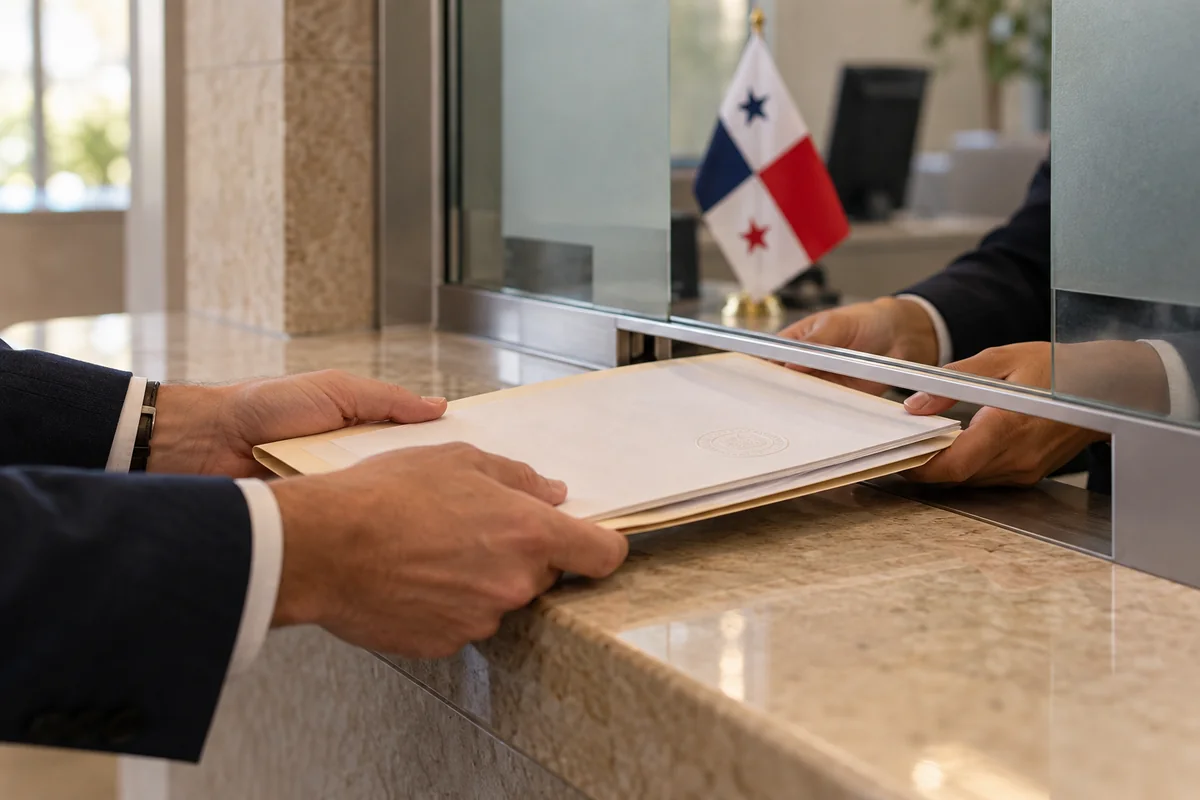
AI-generated illustration of a consular document submission; not an actual Panamanian consulate.
Apostille or Panamanian Consular Legalization?
An apostille replaces traditional consular legalization for eligible public documents when the Hague Apostille Convention applies between the country of origin and Panama. It is issued by a designated competent authority in the country where the public document originates.
Where the Convention applies, a properly apostilled document does not require additional authentication by a Panamanian consulate merely to certify its signature or seal. Translation, document validity and the substantive requirements of the receiving institution remain separate matters.
If the Convention does not apply to your document, consular legalization may be required. Confirm the necessary certifications with the Panamanian consulate before submitting the original.
Consult the HCCH Apostille Section for participating countries, competent authorities and guidance on when the Convention applies.
Legalization of Documents by the Panamanian Consulate
Consular legalization generally involves a chain of certifications rather than a single apostille. Depending on the document and country, local notarization or authentication may be necessary before the Panamanian consulate can act.
- Confirm the receiving authority’s requirements. Identify the document, acceptable format, issuing authority and any applicable validity period.
- Obtain the correct original or certified copy. A regular photocopy may not satisfy the requirements.
- Complete any preliminary certifications. Ask the consulate whether notarization or certification by another authority in the country of origin is required.
- Submit the document to the appropriate Panamanian consulate. Follow that office’s instructions for identification, appointments, fees and delivery.
- Complete the authentication in Panama. For documents legalized through this route, Panama’s Ministry of Foreign Affairs authenticates the signature of the Panamanian consular official.
For information about the final stage, consult Panama’s Ministry of Foreign Affairs authentication and legalization services.
Documents to Prepare Before Contacting the Consulate
Requirements vary by document and office. Before arranging an appointment or mailing originals, ask the consulate to confirm:
- Whether an apostille should be used instead of consular legalization.
- Whether it requires an original, an issuing-authority certified copy or a notarized document.
- Which signatures and seals must appear and whether preliminary authentication is necessary.
- Whether identification, a covering letter or supporting documents are required.
- The current fee, payment method, processing arrangements and return-delivery instructions.
Birth and marriage certificates, police certificates, pension letters, powers of attorney and academic records can follow different procedures. Do not assume that instructions for one document apply to another.
For residency applications, also review our guide to Panama criminal background checks and the requirements of the relevant Panama residency program.
Consular Fees and Mailing Documents
Fees and submission instructions must be confirmed with the office handling your documents. Washington’s published requirements should not be treated as a universal policy for every Panamanian consulate.
The Embassy of Panama’s Washington legalization page currently lists a fee of $30 per document, payment by money order and a prepaid return envelope. It also describes a limited fee exemption for qualifying recently issued academic documents belonging to Panamanian citizens. Check the Washington office’s official legalization instructions for the applicable conditions and any changes before paying or sending documents.
If mailing is accepted, confirm the destination address, required enclosures and courier-label instructions directly with that office. Keep copies and tracking details. Do not send every application to Washington solely because its address appears in a general guide.
Panamanian Consulates in the United States
If you are searching for a Panamanian consulate near you, start with the Embassy of Panama’s official consular directory organized by state or territory.
Select your location to find the designated office. Confirm that it provides the particular authentication or notarial service you need; geographic proximity alone does not establish which office should handle your documents.
For inquiries concerning Washington, New York, Miami, Tampa, Houston, Philadelphia, New Orleans or the Los Angeles area, use the official directory rather than relying on older addresses, telephone numbers or jurisdiction tables.
Outside the United States, contact the Panamanian embassy or consulate responsible for the country where your document originates. If there is no local Panamanian office, request instructions from Panama’s Ministry of Foreign Affairs or the responsible mission before arranging an alternative legalization route.
Translations and Document Validity
An apostille or consular authentication does not translate a document or guarantee that it satisfies the requirements of a residency application, court, bank or other institution.
For documents issued in a language other than Spanish, confirm whether a translation by an authorized public translator is required and how the complete document, including certifications, should be translated.
Also confirm the required issue date and validity period before ordering certificates. Authentication does not make an outdated or unsuitable certificate acceptable for a particular procedure.
Frequently Asked Questions About Panama Document Authentication
Do I need both an apostille and Panamanian consular authentication?
For an eligible public document covered by the Apostille Convention, an apostille replaces consular legalization. Additional consular authentication is not required merely to authenticate the same signature or seal. Other requirements, such as translation and an acceptable document format, may still apply.
Can I obtain an apostille in Panama for a foreign document?
The apostille for a foreign public document is normally obtained from the designated competent authority in its country of origin. Panama’s apostille procedure for Panamanian documents is a different process.
Can I mail documents instead of visiting a consulate?
Some offices accept documents by mail, but the service, required identification, payment method and return arrangements must be confirmed with the office handling your request.
Does authentication guarantee acceptance of my document?
No. Authentication concerns the origin of the document, including the relevant signature, official capacity or seal. It does not certify the truth of its contents or guarantee acceptance for a specific legal procedure.
What if there is no Panamanian consulate near me?
First check whether the apostille procedure applies. If consular legalization is necessary, ask the responsible Panamanian mission about its jurisdiction and available submission options before sending documents or using a third-country consulate.
Assistance with Documents for Use in Panama
International Relocation Firm can help review the document requirements for your Panama legal or immigration matter and identify the authentication and translation steps to confirm before submission.
Contact us before ordering or mailing documents so we can review their intended use and the requirements of your case.
Last updated: October 29, 2026.